Read, How are earthqukes measured.... HW DUE_____Tuesday, 4/14/11
.
Think deeply
Answer the following questions:
Name: ________________________
1.Fill in the blank: The size of an earthquake is considered it's ____________________
2.Comparison, (example fries are to ketchup as rice is to soy sauce)
Magnitude is to earthquakes as ____________________- is to __________________
3.The richtor scale is a log scale. So a richter scale 2 is _____ times greater than a richter scale 1.
And a richter scale 8 is ________ times greater than a richter scale 5.
4.What is the Modified Mercalli scale?
5.Plate tectonics theory states that crusts are _______________ kilometers thick.
6.There are three different types of plate boundaries. These boundaries are:
__________________ ______________________ ___________________________
7.What states are next to the Cascadia subduction zone?
____________________ ______________________ ___________________________
8.The earth is made of how many major tectonic plates? ____________________
9.What type of an EQ is a magnitiude 8 +? _____________
10. What would be a symptom or characteristic of a Modified Mercalli XI, in regular persons words:
Thursday, April 14, 2011

Tuesday, April 5, 2011
Geology Reading Assignment, Given 4/5 due 4/7
Group 1: Read http://news.yahoo.com/s/ac/20110311/wl_ac/8043106_japanese_earthquake_makes_top_five_on_richter_scale_since1900 If you can't get the link to work see it at our blog, trilliumgeology.blogspot.com
Answer these questions on a separate piece of paper.
1.What was the richter scale of the recent Japan earthquake according to the USGS.
2.Name a richter scale 9 quake. When, where, and how many people died in that?
3.What date was the Alaskan Prince William Sound?
4.How do we know the Alaskan quake was a subduction zone quake
5.How many died in the 2004 quake?
6.Where was the 2004 quake and why did so many die?
Draw a subduction zone labeling the oceanic plate, aesthenosphere, convection current, continental plate, subduction zone, trench, and associated volcanic range.
Group 2. Read.
http://www.foxnews.com/scitech/2011/03/11/earthquake-science-japanese-quake-explained/
Answer these questions:
1.How quickly does the pacific plate move?
2.What is the result of that movement?
3.What kind of scale is the richter scale based on?
4.Compare what strength a 3 vs a 4 quake would be.
5.What about a 4 vs a 7?
6.What is the most people died in an earthquake, and where is that plate?
*How far will the plate move in 74 years?
Draw a sketch (or print out a map) of the pacific ring of fire Japan, China, the US (including Alaska), Canada, Mexico and Chile. Drawing and labeling the mid pacific ridge, the direction of the plate spreading, labeling the rate at which it is spreading. Draw volcanoes where you would predict them.
Group 3. Read
http://serc.carleton.edu/vignettes/collection/25559.html
Answer the following questions:
1.What is a megathrust quake?
2.Why have they focused on the area they focused on?
3.Why do people hang out there?
4.Fill in the blanks: Such stories provide compelling evidence for _________ coseismic uplift followed by ___________ postseismic and inter___________.
5.Explain that In 6th grader terms
6.What does this have to do with Oregon, or the Japanese quake?
*any ideas how we might be able to predict quakes from this kind of event?
Draw a subduction zone labeling the oceanic plate, continental plate, subduction zone, trench, and associated volcanic range MOST IMPORTANTLY WHAT THEY MEAN BY COASTAL UPLIFT.
Group 4: Read
http://iphoneincubator.com/blog/products/itemblor
Answer these questions,
1.What is the difference between the richter scale and MMI scale numerically?
2.What is the nature of the richter scale?
3.What is the nature of the MMI scale?
4.Do I want to live in a masonry A or D building? Why?
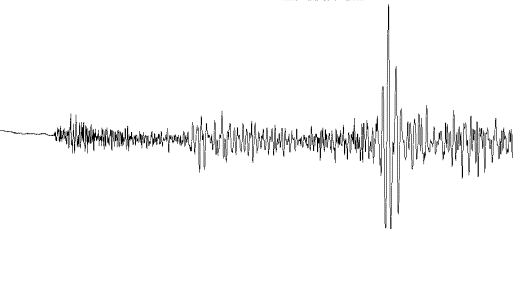
5.Look at the below seismogram. Label primary, secondary, and Lwaves.
6.Describe where you think the p, s, and l wave would be on a MMI scale.
Group 5:. Read.
http://www.foxnews.com/scitech/2011/03/11/earthquake-science-japanese-quake-explained/
Answer these questions:
1.What is the nature of the article? Educational, informative, or entertainment
2.Why do you think people might read this (if they weren't in a class)
3.The richter scale is what kind of scale?
4.Come up with an analogy that would help describe that relationship. (something a 6th grder could understand)
7.What is the most people died in an earthquake, and where is that plate?
*How far will the plate move in 60 years?
Draw a subduction zone labeling the oceanic plate, aesthenosphere, convection current, continental plate, subduction zone, trench, and associated volcanic range.
Answer these questions on a separate piece of paper.
1.What was the richter scale of the recent Japan earthquake according to the USGS.
2.Name a richter scale 9 quake. When, where, and how many people died in that?
3.What date was the Alaskan Prince William Sound?
4.How do we know the Alaskan quake was a subduction zone quake
5.How many died in the 2004 quake?
6.Where was the 2004 quake and why did so many die?
Draw a subduction zone labeling the oceanic plate, aesthenosphere, convection current, continental plate, subduction zone, trench, and associated volcanic range.
Group 2. Read.
http://www.foxnews.com/scitech/2011/03/11/earthquake-science-japanese-quake-explained/
Answer these questions:
1.How quickly does the pacific plate move?
2.What is the result of that movement?
3.What kind of scale is the richter scale based on?
4.Compare what strength a 3 vs a 4 quake would be.
5.What about a 4 vs a 7?
6.What is the most people died in an earthquake, and where is that plate?
*How far will the plate move in 74 years?
Draw a sketch (or print out a map) of the pacific ring of fire Japan, China, the US (including Alaska), Canada, Mexico and Chile. Drawing and labeling the mid pacific ridge, the direction of the plate spreading, labeling the rate at which it is spreading. Draw volcanoes where you would predict them.
Group 3. Read
http://serc.carleton.edu/vignettes/collection/25559.html
Answer the following questions:
1.What is a megathrust quake?
2.Why have they focused on the area they focused on?
3.Why do people hang out there?
4.Fill in the blanks: Such stories provide compelling evidence for _________ coseismic uplift followed by ___________ postseismic and inter___________.
5.Explain that In 6th grader terms
6.What does this have to do with Oregon, or the Japanese quake?
*any ideas how we might be able to predict quakes from this kind of event?
Draw a subduction zone labeling the oceanic plate, continental plate, subduction zone, trench, and associated volcanic range MOST IMPORTANTLY WHAT THEY MEAN BY COASTAL UPLIFT.
Group 4: Read
http://iphoneincubator.com/blog/products/itemblor
Answer these questions,
1.What is the difference between the richter scale and MMI scale numerically?
2.What is the nature of the richter scale?
3.What is the nature of the MMI scale?
4.Do I want to live in a masonry A or D building? Why?
5.Look at the below seismogram. Label primary, secondary, and Lwaves.
6.Describe where you think the p, s, and l wave would be on a MMI scale.
Group 5:. Read.
http://www.foxnews.com/scitech/2011/03/11/earthquake-science-japanese-quake-explained/
Answer these questions:
1.What is the nature of the article? Educational, informative, or entertainment
2.Why do you think people might read this (if they weren't in a class)
3.The richter scale is what kind of scale?
4.Come up with an analogy that would help describe that relationship. (something a 6th grder could understand)
7.What is the most people died in an earthquake, and where is that plate?
*How far will the plate move in 60 years?
Draw a subduction zone labeling the oceanic plate, aesthenosphere, convection current, continental plate, subduction zone, trench, and associated volcanic range.
Sunday, March 27, 2011
Natural Disaster Interview
Directions: Interview a Survivor of a natural disaster.
What Kind?
The magnitude of that natural disaster had to be big enough that people died or could have died. The survivor must feel like they have SURVIVED the experience.
What Questions?
These might be good places to start: Where were you? How old were you? Where were you when it started? How did you know it had started? What were you feeling, what went through your head when you realized it was starting? What did you do to protect yourself and those you were with? Did anyone die? What was it like when it was over? Was anything destroyed? Were you able to go back to work/school? Did you know anyone who lost their work/school? Did you have nightmares or dreams about it? What do you think you would do if you were in that situation again? Do you have an emergency kit?
Rules:
Interviewee must NOT be in your immediate family. (i.e. must be a relative you don't live with) OR an adult not at the school. No teachers or adults at the school. No fellow geology students.
Product:
For the first phase of the project we'll present to the class on April 5th, the first day back from break. Bring any documentation, video, audio, notes on paper. Be able to sum up the experience for your peers. Later we will develop it into a project that students will then make into a meaningful product attached to a field they may later choose to study.
Reasoning/Inspiration/Follow Up
The goal of this project is to "bring home" the experience of a natural disaster by having students interview a friend or non-immediate family member as to their experience of a natural disaster. State and national science benchmarks outline this kind of experience as a meaningful experience that will enrich, inform, and motivate a student's study of natural disasters.
More information can be found: On this site
What Kind?
The magnitude of that natural disaster had to be big enough that people died or could have died. The survivor must feel like they have SURVIVED the experience.
What Questions?
These might be good places to start: Where were you? How old were you? Where were you when it started? How did you know it had started? What were you feeling, what went through your head when you realized it was starting? What did you do to protect yourself and those you were with? Did anyone die? What was it like when it was over? Was anything destroyed? Were you able to go back to work/school? Did you know anyone who lost their work/school? Did you have nightmares or dreams about it? What do you think you would do if you were in that situation again? Do you have an emergency kit?
Rules:
Interviewee must NOT be in your immediate family. (i.e. must be a relative you don't live with) OR an adult not at the school. No teachers or adults at the school. No fellow geology students.
Product:
For the first phase of the project we'll present to the class on April 5th, the first day back from break. Bring any documentation, video, audio, notes on paper. Be able to sum up the experience for your peers. Later we will develop it into a project that students will then make into a meaningful product attached to a field they may later choose to study.
Reasoning/Inspiration/Follow Up
The goal of this project is to "bring home" the experience of a natural disaster by having students interview a friend or non-immediate family member as to their experience of a natural disaster. State and national science benchmarks outline this kind of experience as a meaningful experience that will enrich, inform, and motivate a student's study of natural disasters.
More information can be found: On this site
Monday, January 10, 2011
First Semester Final Project
Final project info can be found at: http://hanta.wikispaces.com/Geology+1st+Semester+Project
It is a research project/and experiment about a mineral or mined product, it's impacts on the environment. Remember the paper must follow the outline described on the page above (same as the handout in class)
As always, contact me with questions, nina@trilliumcharterschool.org
It is a research project/and experiment about a mineral or mined product, it's impacts on the environment. Remember the paper must follow the outline described on the page above (same as the handout in class)
As always, contact me with questions, nina@trilliumcharterschool.org
Monday, December 20, 2010
Abandoned Mines in Oregon
AMD. Abondoned mine drainage has proven to be quite a problem. This is a creek that flows away from a coal mine in Pennsylvania:

Above picture part of a film, Hope For Polluted Rivers

Above, a copper mine superfund site.
More on abandoned mine pollution
Famous story of Geese landing in the Berkely Pit Mine in Montana and the carcass and fungal remains producing biocontainment organisms. Kinda cool, kinda terribly sad for the geese.

Above picture part of a film, Hope For Polluted Rivers

Above, a copper mine superfund site.
More on abandoned mine pollution
Famous story of Geese landing in the Berkely Pit Mine in Montana and the carcass and fungal remains producing biocontainment organisms. Kinda cool, kinda terribly sad for the geese.
Sunday, December 12, 2010
Topographic Maps, An introduction to mining
This one may be a little more recognizable to some of us more than others.
Topographic maps help us recognize changes of elevation. They never cross. Ideally they never touch. They are an excellent plotline for a CSI episode whereby a man kills his competitor by coloring in more topo lines on the map. Super geeky, I know.
Thursday, December 2, 2010
Test Questions for Rocks, Minerals, Chemistry
1. What are the four rock processes?
2.What process does a rock undergo to become an igneous rock.
3.What kind of rock is Granite?
4.What kind of rock is galena?
5.A name for a rock made of tiny tiny crushed seashells.
6.If an igneous rock would undergo change and become a metamorphic rock what process would it have to undergo?
7.Describe the change that took place when we made our clay models of the process to make metamorphic rock.
8.What are the two subprocesses of sedimentary rock formation?
9.Name two types of metamorphic rock.
10.Basalt is crushed with a hammer 1000 times and becomes very small particles. What process did it undergo?
11.A rock that is a collection of igneous, metamorphic, and sediment stuck together.
12.Name two sedimentary rocks.
13.Name two intrusive igneous rocks
14.Name two metamorphic rocks
15.Name four types of sediment.
16.How would you describe the appearance of a generic sedimentary rock?
17.How would you describe the appearance of a generic metamorphic rock.
18.How would you describe the appearance of an intrusive igneous rock?
19.What are the characteristics that allow us to differentiate minerals?
20.If the atomic number of Sodium is 11 and the atomic mass is 23 how many protons does Sodium have?
21.If NaCl is the chemical formula of a mineral, what is that mineral..
22.If the atomic number of Sodium is 11 and the atomic mass is 23 how many neutrons does it have?
23.Draw the Bohr model for Sodium
24.If NaCl is the chemical formula of a mineral, what is that mineral..
25.Au is the chemical make up of a mineral, what is that mineral?
26.
2.What process does a rock undergo to become an igneous rock.
3.What kind of rock is Granite?
4.What kind of rock is galena?
5.A name for a rock made of tiny tiny crushed seashells.
6.If an igneous rock would undergo change and become a metamorphic rock what process would it have to undergo?
7.Describe the change that took place when we made our clay models of the process to make metamorphic rock.
8.What are the two subprocesses of sedimentary rock formation?
9.Name two types of metamorphic rock.
10.Basalt is crushed with a hammer 1000 times and becomes very small particles. What process did it undergo?
11.A rock that is a collection of igneous, metamorphic, and sediment stuck together.
12.Name two sedimentary rocks.
13.Name two intrusive igneous rocks
14.Name two metamorphic rocks
15.Name four types of sediment.
16.How would you describe the appearance of a generic sedimentary rock?
17.How would you describe the appearance of a generic metamorphic rock.
18.How would you describe the appearance of an intrusive igneous rock?
19.What are the characteristics that allow us to differentiate minerals?
20.If the atomic number of Sodium is 11 and the atomic mass is 23 how many protons does Sodium have?
21.If NaCl is the chemical formula of a mineral, what is that mineral..
22.If the atomic number of Sodium is 11 and the atomic mass is 23 how many neutrons does it have?
23.Draw the Bohr model for Sodium
24.If NaCl is the chemical formula of a mineral, what is that mineral..
25.Au is the chemical make up of a mineral, what is that mineral?
26.
Subscribe to:
Posts (Atom)